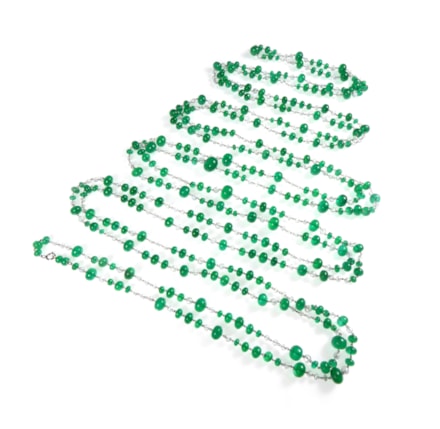
the fancy interlinked gold flexible rope chain spaced by sixteen graduated polished emerald beads, these variously oval-ish in shape, flanked by reeded gold collarettes each of which set around with four rose cut diamond collets, ropetwist wirework detail, inscribed 'RIVAUD', together with a fitted case with gilt stamp of Charles Rivaud: 'CH. RIVAUD. 20, rue Truffaut, PARIS'.
These smoothly polished irregular emerald beads were likely sourced in India, where French jewellers were known to acquire such gemstones. India in turn had been sourcing these types of emeralds from Colombia for hundreds of years.
Whilst emeralds had been enjoyed in India since antiquity, it was the fine richly coloured emerald material of Colombia that had captivated Indian buyers since their arrival in the 16th century.
Imported through Spanish and Portuguese merchants from the 1500's, emeralds and other precious gemstones had inspired a flourishing tradition of lapidary work and carving, particularly in Jaipur. Under the patronage of the Mughal courts they became highly prized, valued for both their beauty and craftsmanship.
In India, the emeralds were cut into smooth, polished beads, like those of this chain, or carved into fluted forms or with intricate motifs of flowers and leaves. Often repurposed from earlier pieces, for instance bead necklaces unstrung and reassembled - these antique-cut gems appealed to European jewellers, who valued their distinctive character and the depth of colour achieved through earlier cutting techniques. Their use can be seen notably in French jewellery of the late 19th and 20th centuries.
Charles Rivaud (1859-1923)
A champion of jewellery and the wider decorative arts, Charles Rivaud was a jeweller and goldsmith working in Paris in the late 19th and early 20th centuries. As well as working in collaboration with other artists, Rivaud's jewellery was sold under his own name in his own premises.
As one of the go-to jewellers for realising medal designs, he worked with Jean Dampt, Victor Prouve and the sculptor Oscar Roty, with whom he produced a bangle commemorating the centenary of the French Revolution in 1889, examples of which can occasionally be seen at auction in both gold and silver.
Described as working in the 'Neo-Merovingian' style in the Jewelers' Circular August 9, 1905, this emerald, gold and rose cut diamond bead necklace fits well into the design genre of early medieval revival.
He organised smaller exhibitions for his own work and that of other decorative artists, was an award winning exhibitor at the Paris salons and was involved also as a judge at the larger Paris fairs.
In the 1908 publication 'Les Arts et Les Lettres' by Leon Riotor, (A Lemerre, Paris 1901', pp.136-139), the writer describes one of Rivaud's exhibitions as a 'small paradise of art' including paintings by Henri Martin and Menard and others, bronze sculptures, stone and earthenware pottery. Turning to the jewellery of Rivaud, there are included 'elegant but severe' chains with pectoral pendants, 'luxurious' rings and a harmonious use of the gems and materials, bracelets of light cut-away design. The writer asserts Rivaud is not led by other jewellers such as Massin, Froment-Meurice nor even 'the triumphant' Lalique, but succeeds in creating jewellery as a form of 'conscious decoration'.
A keen educator in his day, his son Andre took over the mantle of the firm after his death in 1923. Length approximately 68cm / 27'' Weight: 131.5g
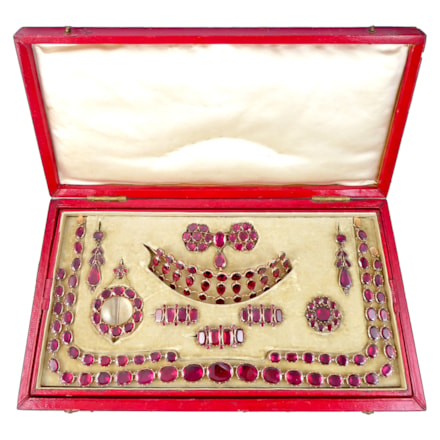
Late 18th century garnet collet suite, c.1800, comprising a necklace with pendant; pair of bracelets; pair of pendant earrings; a coronet shaped brooch converting to hair comb; three line brooches; a round cluster brooch and a twin circular cluster fastener jewel,
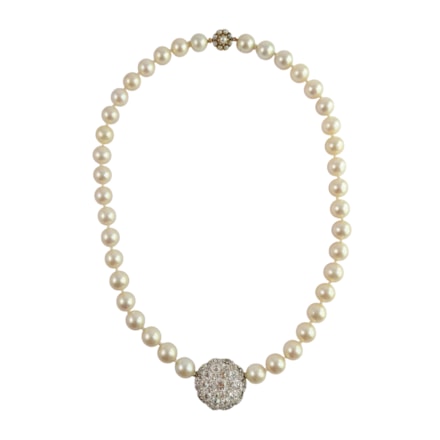
18th century cushion cut diamond cluster panel, c.1780, with a scalloped edge, currently as feature panel to a late 20th century single row cultured pearl necklace,